This paper is authored by Associate Professor Kuan-Hui Elaine Lin of National Taiwan Normal University, Assistant Professor Wan-Ling Tseng of National Tsing Hua University, Distinguished Research Fellow Huang-Hsiung Hsu and and Academician Pao K. Wang of the Research Center for Environmental Changes, among others, and has been selected by PNAS as a featured article.
This study reconstructs a typhoon chronology for the Ming and Qing dynasties based on records of typhoon descriptions documented in Chinese historical sources. The reconstruction was continued with modern observations to establish a Northwestern Pacific typhoon database extending back to 1368. This research was supported on a multi-year funding from the Center for Sustainability Science since 2014, under the leadership of Academician Pao K. Wang. The effort resulted in the completion of REACHES, the first digitized historical climate database in East Asia, which is openly accessible to scholars worldwide.
The present study systematically extracts typhoon-related information from the REACHES and validates the reconstruction by comparison with early instrumental observations. The analysis reveals pronounced centennial-scale and multidecadal variability in typhoon activity. Notably, the period with the highest typhoon frequency (1650–1680) coincides with the Maunder Minimum during the Little Ice Age and exhibits clear seasonal variability.
Full Paper
:https://doi.org/10.1073/pnas.2419759122
PNAS In This Issue December 30, 2025: https://doi.org/10.1073/iti522512
REACHES website: https://reaches.rcec.sinica.edu.tw/
Reference:
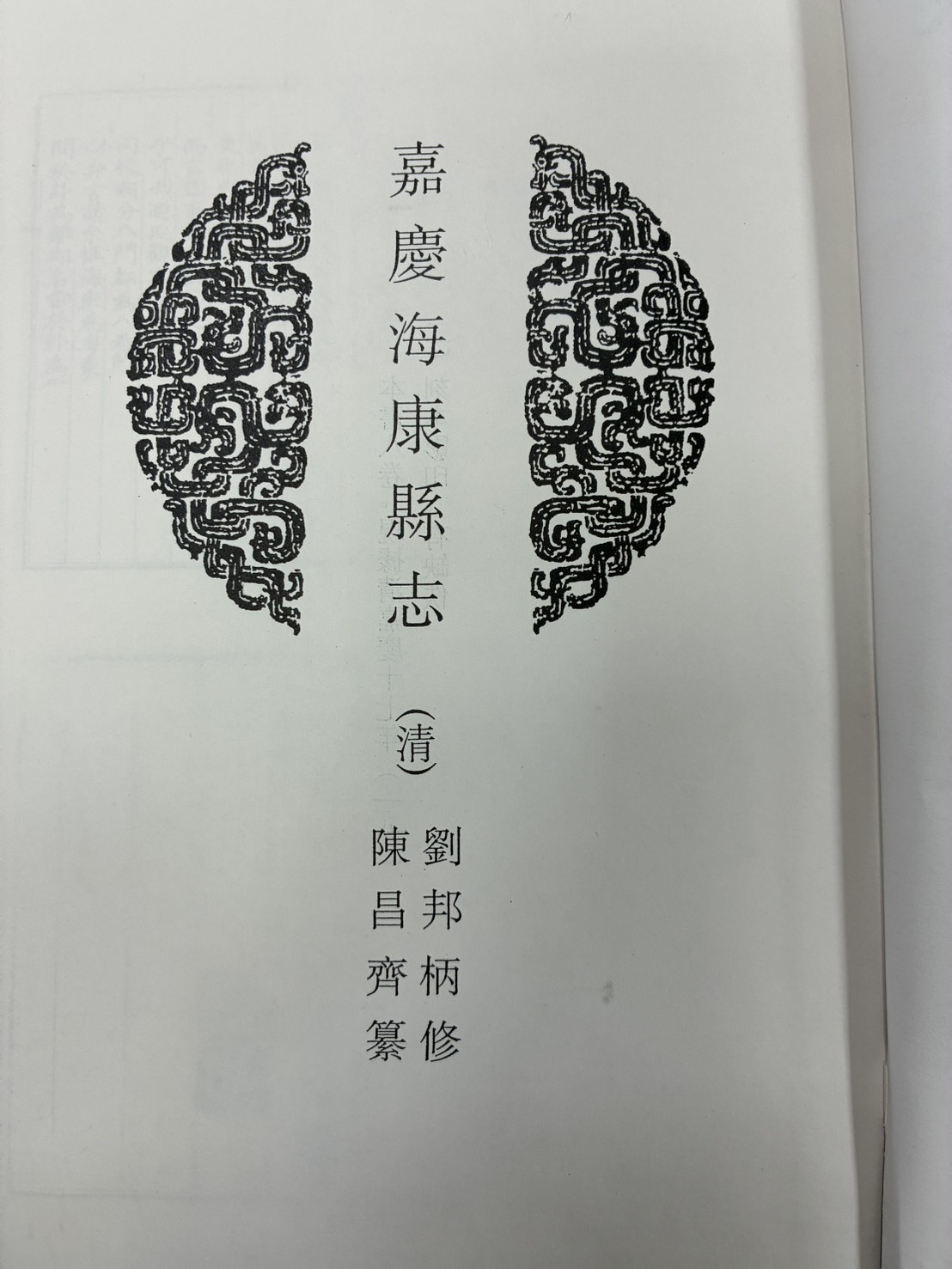

Figure 1. Description of multiple typhoons in the 16th (1588) and 18th years (1590) of the Wanli reign (Ming dynasty) from the Annals of Haikang County, Guangdong Province.
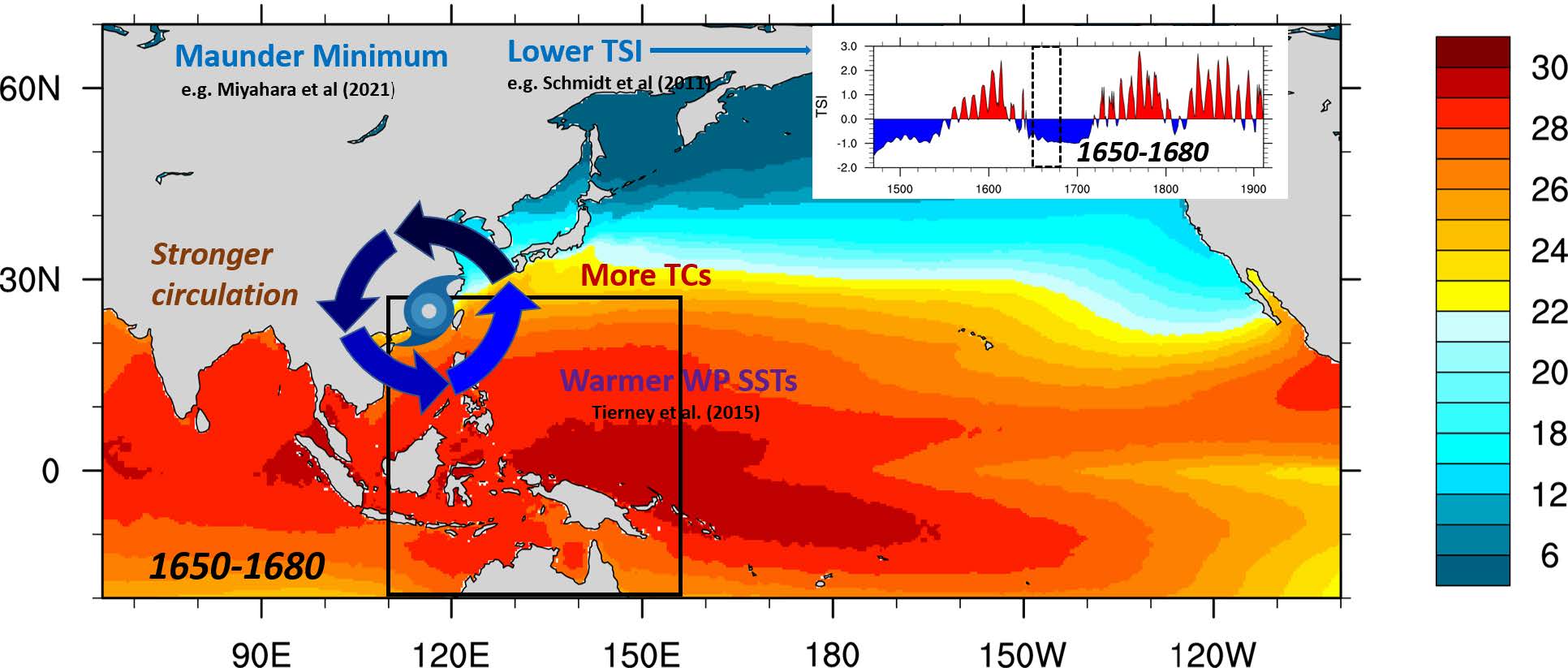
Figure 2. The peak typhoon period of time (1650-1680) coincided with the Maunder Minimum, a period of decreased solar irradiance and cold land temperatures. Marine proxy reconstructions suggest that ocean temperatures were anomalously warm over the western Pacific. This land-sea temperature disparity may have intensified general circulation contributing to active typhoon activity. Source: Lin et al. (2025) in PNAS.